

The aviation sector is highly dependent on top-notch, fast, and low-latency digital video systems for cockpit displays, mission systems, and sensor integration.
To satisfy the high demand for such systems, ARINC 818 was developed, which opened up a market where uncompressed digital video transmission in avionics could be applied in a standardized way.
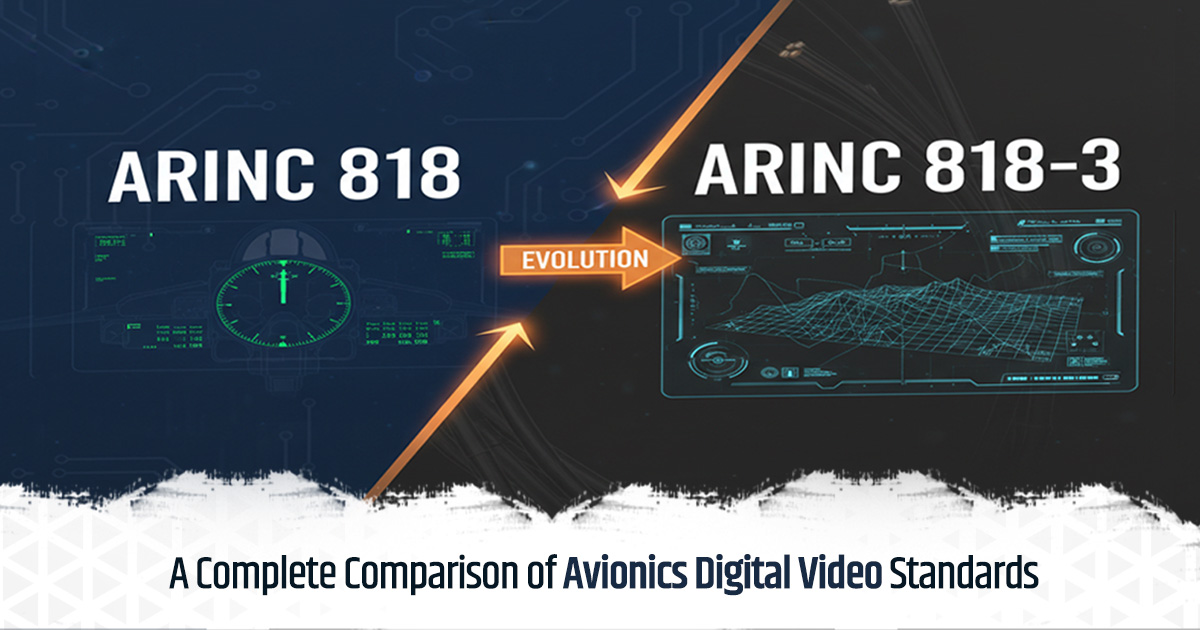
The standard has changed its face through time with such revisions as ARINC 818-2 and ARINC 818-3, which introduced not only the aforementioned higher data rates, but also improved encoding methods, latency management, and support for high-end applications like 4K/8K displays and windowless cockpits.
This blog explores the journey of ARINC 818, highlighting the key differences between each revision and their significance in modern avionics systems.
ARINC
Aeronautical Radio, Incorporated (ARINC), founded in 1929, was a leading supplier of systems engineering and transport communications solutions for eight industries: infrastructure, networks, security, healthcare, aviation, airports, defense, and government.
Standards for line-replaceable units are maintained by ARINC, which also deployed computer data networks in police cars and railroad coaches.
ARINC 818
ARINC 818: A video interface and protocol standard called Avionics Digital Video Bus (ADVB) was created for avionics systems that require high bandwidth, low latency, and uncompressed digital video transmission.
Since its January 2007 release, ARINC and the aerospace community have worked to advance the standard to meet the demanding requirements of high-performance digital video.
For uncompressed, high-bandwidth, low-latency digital transmission that is ideal for live video, ARINC 818 is a high-speed video and data protocol standard.
In order to transmit video, graphics, and other avionics data within aircraft systems, the military and aerospace industries make extensive use of ARINC 818.
ARINC 818 is widely used in mission and video processors, optical and infrared sensors, head-up displays, helmet-mounted displays, and high-resolution cockpit displays.
It was created in response to the growing need for more effective communication and greater bandwidth in contemporary avionics systems.

Benefits of ARINC 818 (ADVB)
The Avionics Digital Video Bus (ADVB), commonly referred to as ARINC 818, provides a number of benefits for mission-critical, high-speed video transmission in aerospace and defense applications.
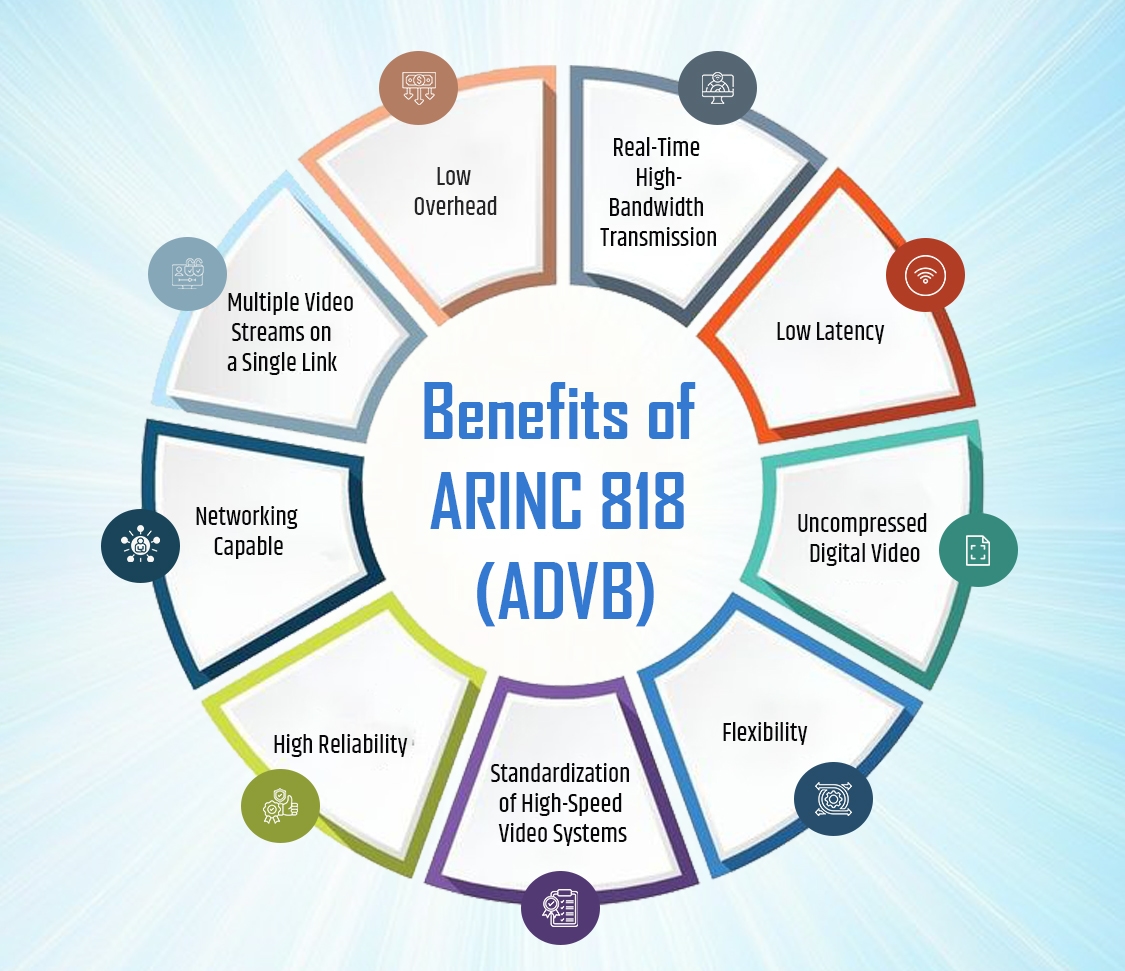
- Low Overhead: The protocol’s efficient architecture maximizes usable bandwidth and reduces needless data processing.
- Real-Time High-Bandwidth Transmission: It is perfect for applications that need instant video feedback since it allows the transport of video signals in real time at high data speeds.
- Low Latency: For time-sensitive avionics systems, ARINC 818 guarantees low video transmission latency, which is essential.
- Uncompressed Digital Video: Uncompressed video transmission is supported by the standard, preserving the best possible video quality.
- Flexibility: ARINC 818 is easily adaptable to many system requirements because it is not dependent on any one physical layer or video format.
- Standardization of High-Speed Video Systems: It offers a chance to standardize video transmission across platforms, making system integration and design easier.
- High Reliability: Even in difficult operational conditions, ARINC 818 guarantees data integrity with two layers of error checking.
- Networking Capable: By supporting networked configurations, the standard makes it possible to manage video data across several devices effectively.
- Multiple Video Streams on a Single Link: It maximizes system resources by enabling the simultaneous transmission of numerous video streams over a single connection
Because of these features, ARINC 818 is a strong and adaptable standard for contemporary avionics video systems, guaranteeing excellent performance, dependability, and flexibility.
The Evolution of ARINC 818 Standards
In order to meet the rigorous criteria of high-performance digital video, ARINC and the aerospace community have been working to improve the standard since its inception in January 2007.
After the specification was upgraded, ARINC 818-2 was released in December 2013 with a number of new features, including data-only links, bi-directional control, field sequential color, channel-bonding, switching, and link rates up to 32X fiber channel rates.
ARINC 818-3 was released in 2018.
In addition to fixing several problems, this version emphasized the distinctions between the 64b/66b and 8b/10b encoding rates.
ARINC 818 vs ARINC 818-2 vs ARINC 818-3 – A Comparative Overview
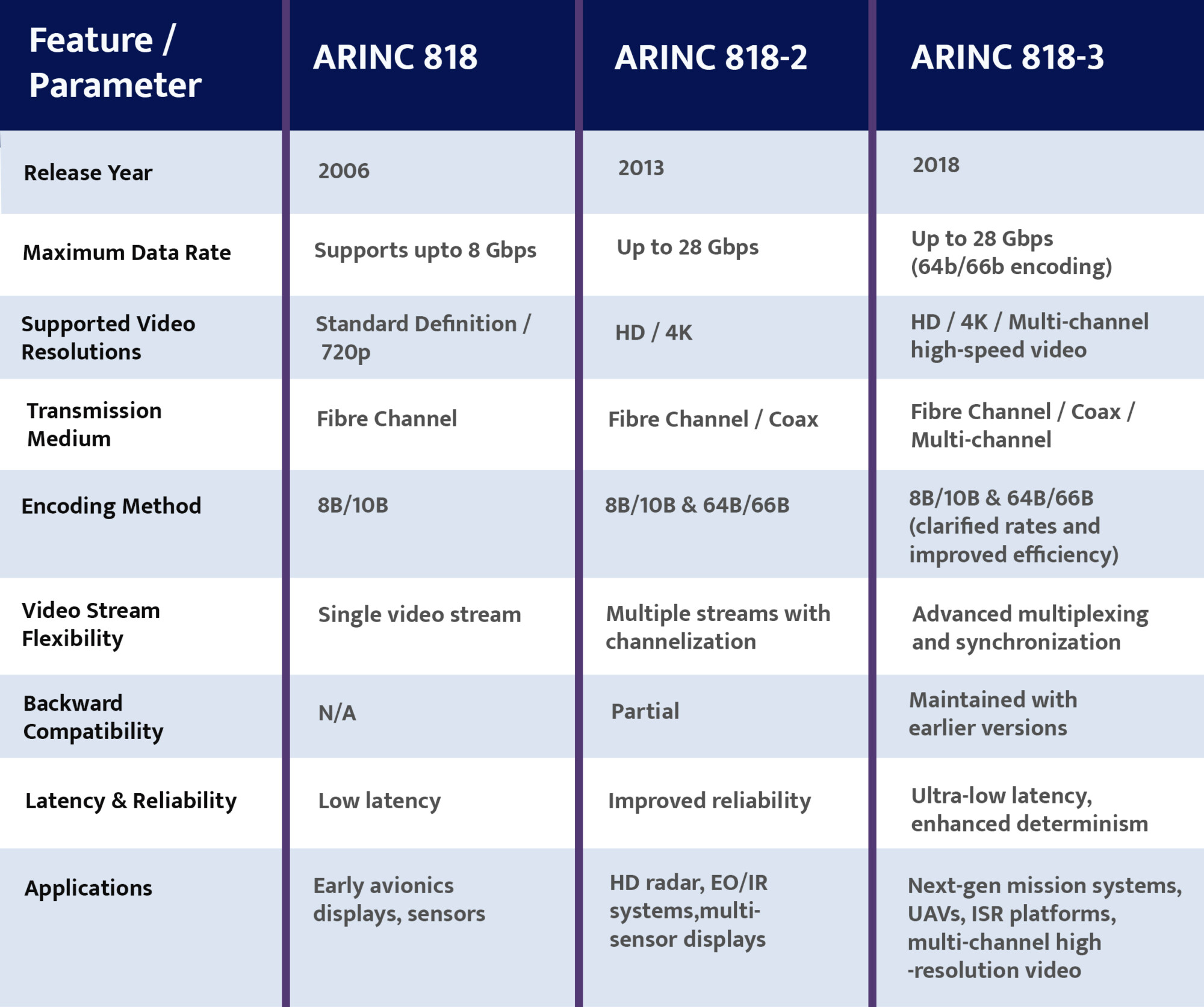
Detailed Breakdown of ARINC 818 -2 and ARINC 818 -3
ARINC 818-2
In order to handle faster link rates, networking, encryption, and compression, and advanced display systems including channel bonding for large area displays (LADs), ARINC 818-2 was ratified in December 2013.
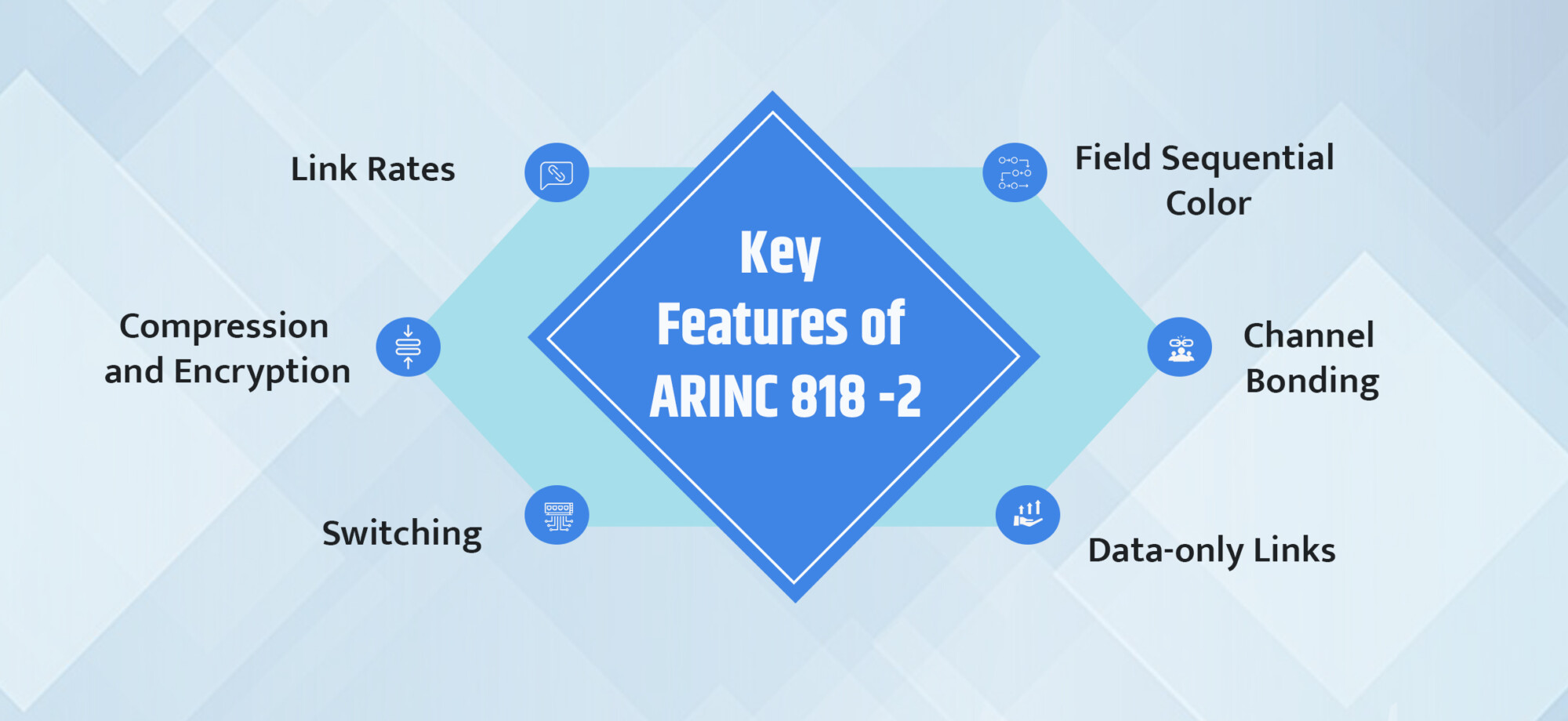
Key Features of ARINC 818 -2
Link Rates:
ARINC 818-2 enabled specific link speeds for low-speed applications such as camera control, and introduced higher rates up to 28.05 Gb/s, after initially supporting up to 8.5 Gb/s.
Compression and Encryption:
Compressed or encrypted payloads are allowed by ARINC 818-2; however, the ICD specifies how they should be implemented. Only flags that indicate encryption or compression are used by the protocol.
Switching:
ARINC 818-2, which was first point-to-point, now allows frame-level switching for numerous channels or displays, guaranteeing smooth video by only switching when vertical blanking occurs.
Field Sequential Color:
Field-sequential color, in which each color component is transmitted in a different container, was supported by the addition of a new video format code.
Channel Bonding:
By splitting a video frame across many links, each carrying a full ADVB frame, ARINC 818-2 allows multi-link transmission to overcome FPGA bandwidth limitations. The ICD controls latency and skew.
Data-only Links:
For command-and-control applications such as camera interfaces, ARINC 818-2 provides data-only links that support both standard and bespoke link rates as specified in the ICD.
Applications of ARINC 818 -2
Advanced Avionics Displays: Enables high-speed, low-latency video transmission for cockpit, mission, and head-up displays in commercial and military aircraft.
Sensor Fusion Systems: integrates data from several sensor outputs, including radar, infrared, and electro-optical, via a single high-speed channel.
UAV and UAS Video Links: Allows for the efficient and safe transfer of encrypted or compressed video from aerial platforms to ground stations.
Logic Fruit’s ARINC 818-2 IP Core
A reliable and powerful ARINC 818-2 Transmitter & Receiver IP Core has been created by Logic Fruit Technologies specifically for avionics applications requiring high-resolution, real-time video transmission.
This IP core offers scalable performance for a variety of cockpit display systems and fully supports ARINC 818-2, the improved version of the ARINC 818 standard. It can operate at various line rates up to 8.5 Gbps.
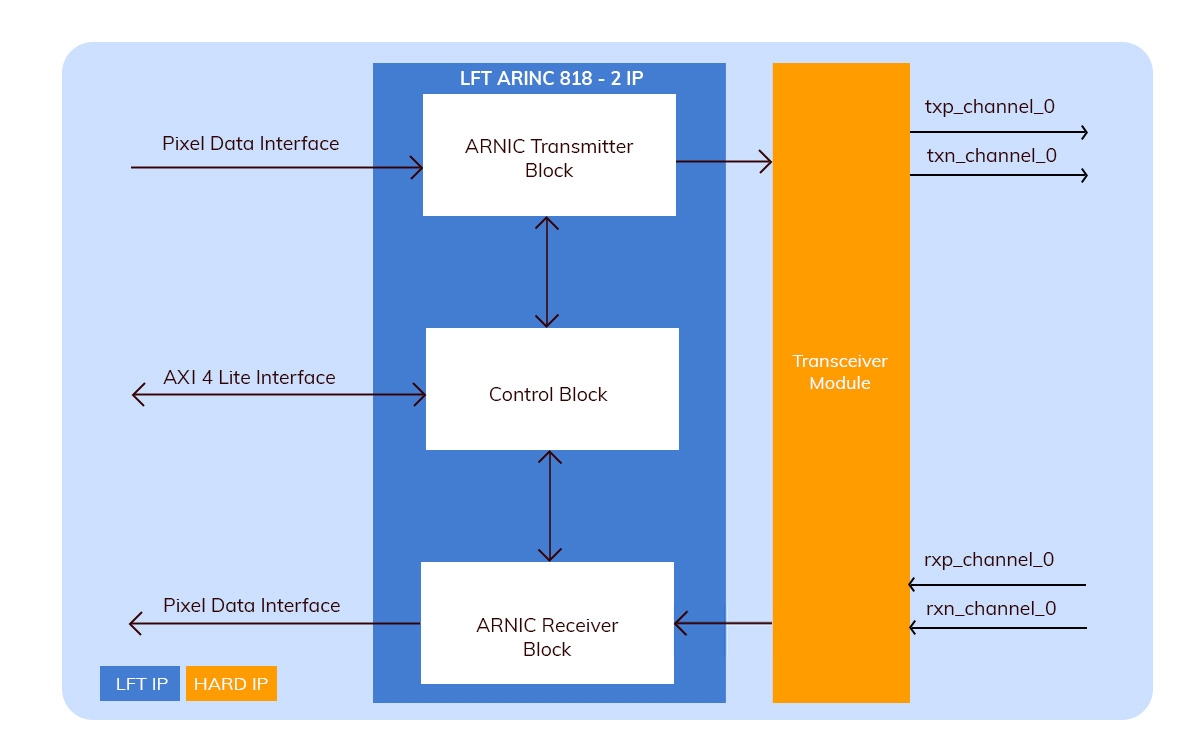
Features of ARINC 818-2 IP Core – Logic Fruit Technologies
- ARINC 818-2 Compliant: Fully aligned with the latest ADVB standard for interoperability.
- High-Speed Transmission: Supports data rates up to 8.5 Gbps for real-time, high-resolution video.
- FC-AV Protocol: Built on a proven Fibre Channel Audio Video framework.
- 8B/10B Encoding: Reliable serial transmission with strong error detection.
- Flexible Interfaces: Supports both optical and electrical links.
- Precise Timing: Line-segmentation and synchronous transmission for accurate video handling.
- Error Monitoring: Receiver reporting with user data support for diagnostics.
- Certified Design: CEMILAC approved and DO-254 DAL-B compliant for aerospace safety.
ARINC 818-3
In order to improve the performance and dependability of high-speed video transmission in avionics systems, ARINC 818-3 was introduced in 2018.
This update made it possible to reliably transmit high-resolution video for sophisticated cockpit and mission systems by clarifying encoding strategies (8b/10b versus 64b/66b), introducing defined latency budgets, improving encoding efficiency, and supporting greater data rates.
Features of ARINC 818-3
Display Emulation Mode: Defines a mode for test equipment to emulate displays for validation and testing purposes.
Latency Budget: Introduces defined latency budgets for ARINC 818 devices in transmit and receive modes to ensure predictable performance.
8b/10b Encoding: Supports up to 10 Gbit/s as the highest speed using 8b/10b encoding.
64B/66B Encoding: Adds support for speeds of 12 Gbit/s and higher using 64B/66B encoding.
High-Speed Bus: Supports 28.05 Gbit/s (FC32X) bus speeds using 256B/257B or 64B/66B encoding for ultra-high data rates.
Applications of ARINC 818-3
- 4K and 8K Displays: Allows for ultra-high-resolution screens in mission systems and cockpits, giving pilots and operators better visibility.
- Windowless Cockpits: Allow for completely digital cockpit designs that use high-definition video feeds from external cameras in place of conventional windows.
- Virtual Reality (VR) Systems: Help VR applications with situational awareness, training, and simulation with fast video streaming.
Logic Fruit’s ARINC 818-3 IP Core
In order to satisfy the sophisticated data and video transmission requirements of next-generation avionics systems, Logic Fruit Technologies has created a high-speed ARINC 818-3 Transmitter and Receiver IP Core that supports line rates of up to 28 Gbps.
High reliability and adherence to strict aerospace requirements are guaranteed by this IP core, which was designed using the DO-254 process and verified by CEMILAC.
It provides reliable, point-to-point serial communication and is perfect for incorporation into mission processors, high-resolution cockpit displays, and other crucial airborne video interfaces.
It is based on the Fibre Channel Audio Video (FC-AV) protocol.
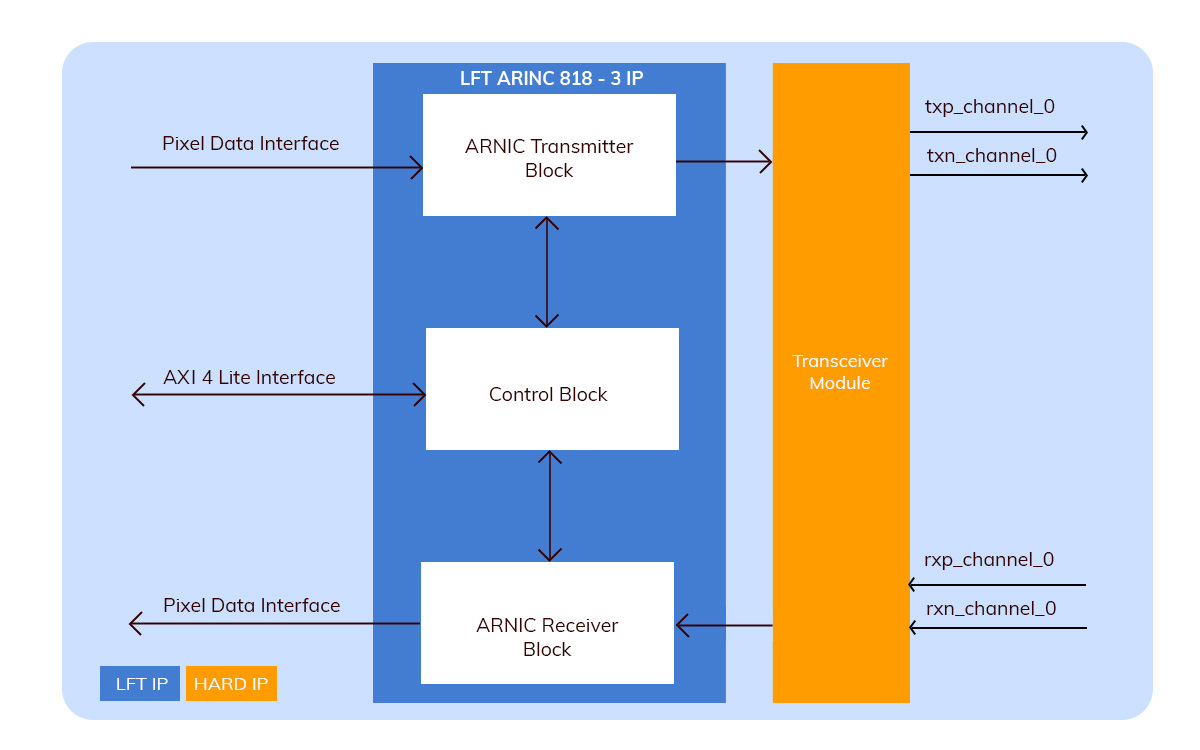
Features and benefits of ARINC 818-3 IP Core
- Compliance: Meets ARINC 818-3 standards for seamless avionics integration.
- Speed: Supports up to 28 Gbps for ultra-high-bandwidth video/data.
- Foundation: Based on robust Fibre Channel Audio Video (FC-AV) protocol.
- Efficiency: Uses 64B/66B and 256B/257B encoding for higher throughput.
- Flexibility: Works with both optical and electrical links.
- Synchronization: Enables precise frame handling with line-segmentation.
- Diagnostics: Offers error detection, reporting, and user data support.
- Certification: DO-254 compliant and CEMILAC certified for safety-critical use.
Conclusion
The evolution from ARINC 818 to ARINC 818-3 is a clear indication that digital video standards for avionics have gone through notable changes to accommodate the increasingly demanding requirements of modern-day aircraft systems.
Every update has introduced important capabilities, faster data rates, better encoding, management of latency, and provision for next-gen displays and sensor systems, so that video transmission is always reliable and performative.
These developments, when grasped, help engineers and system designers to pick out the most compatible standard, thus enhancing the performance of the avionics and making the systems ready for the future, technologically advanced.